You’ve probably heard the pitch before: “Freelance from anywhere, set your own hours, earn what you’re worth.” And you’ve probably filed it away next to all the other things that sound good in theory. You have a real skill. You know other people pay for it. But between “I could do this” and “I have a client and an invoice” there’s a gap that almost no one explains clearly.
This guide on how to start freelancing closes that gap. Not the motivational version, not the “six-figure freelancer” version. The operational one: the specific steps between zero and your first paid project, what to do after that first client, and how to build from there into something that meaningfully changes your FIRE timeline. Whether you want one retainer client or the foundation for full income replacement, the process is the same. It starts here.

Why Freelancing Is One of the Highest-Leverage Income Moves for FIRE
Most income strategies trade time for money at a fixed rate. Freelancing breaks that equation in a way most conventional work doesn’t.
First, there is no income ceiling tied to hours in the way there is with gig platforms. A delivery driver earns per delivery. A freelance copywriter, designer, or analyst earns per project or retainer, and the rate is set by expertise, not supply and demand for labor in a local zip code. As your skills deepen and your reputation builds, rates rise. The ceiling is self-imposed, not structural.
Second, freelancing is one of the few income paths that compounds the FIRE case directly. It adds income to the numerator of your savings rate. If your expenses stay roughly stable while freelance income increases, every extra dollar flows almost entirely into investments. The timeline effect is significant: a modest freelance retainer of $1,000 to $1,500 per month, fully invested, can shave years off a standard FIRE projection. You can model your own numbers with the FIRE Calculator.
Third, and this is the piece that rarely gets enough attention: freelancing gives you something a second job never can. You choose when you work. You choose where you work. There is no commute, no open-plan office, no fixed schedule. A freelance engagement can happen from your home, from a coffee shop, from the other side of the world. For people pursuing Barista FIRE in particular (where the goal is to cover part of your expenses through flexible, part-time work while your portfolio covers the rest), freelancing is often the cleanest fit available. It is part-time by design, location-independent by nature, and pays at professional rates rather than minimum wage. The 9-to-5 structure is optional from day one.
For a broader view of how freelancing fits within the full income growth picture, including salary negotiation, side hustles, and passive income sequencing, see How to Increase Your Income. This guide focuses on the how: the operational steps from no clients to a running freelance income stream.
Step 1: Identify Your Marketable Skill (You Have More Than You Think)
What Counts as a Freelanceable Skill
The most common reason people don’t start is a belief that their skills aren’t specific enough, technical enough, or interesting enough to sell. That belief is almost always wrong.
A freelanceable skill is any capability that someone else needs and would pay to access rather than hire full-time for. That list is longer than most people realize:
- Professional skills: writing, editing, copyediting, proofreading, technical documentation, graphic design, web design, UX/UI design, front-end or back-end development, data analysis, financial modeling, bookkeeping, tax preparation, marketing strategy, SEO, paid advertising, social media management, project management, operations consulting, HR consulting, recruiting
- Knowledge skills: tutoring, language instruction, academic editing, career coaching, interview coaching, presentation design, pitch deck consulting
- Niche professional skills: legal drafting, grant writing, medical writing, scientific editing, translation, voice-over work, video editing, podcast editing
If your job requires a skill that colleagues, clients, or vendors regularly ask you to help with, that skill has a market. The question is not whether it’s valuable. It’s how to package and sell it.
The Skill Audit Exercise
If you’re not immediately sure which skill to lead with, work through three questions:
- What do colleagues, friends, or family regularly ask you for help with?
- What would you finish significantly faster than most people in your professional circle?
- What do people outside your field describe as “complicated” or “technical” that you find routine?
The overlap between your answers is usually where your highest-value freelance offer lives.
Take Sofia. She is a marketing manager at a mid-sized company, responsible for campaign strategy and execution. She spends about two hours a week helping colleagues in other departments write better campaign briefs. She does it without thinking, because it’s fast for her. But to the colleagues asking, it is the hard part of their job. Sofia’s freelanceable skill is not “marketing.” It’s campaign brief development and messaging strategy for non-marketing teams. That specificity is exactly what makes it sellable.
Step 2: Define Your Service (Narrow Beats Broad)
The instinct when starting out is to cast a wide net: “I do marketing,” “I do writing,” “I do design.” It feels safer to keep options open. In practice, it makes it harder to find clients and harder for clients to say yes.
When someone needs help, they search for a solution to a specific problem. “Email copywriter for SaaS onboarding sequences” answers a specific problem. “Copywriter” answers nothing in particular. Narrow positioning does not limit your market: it makes you visible within it.
The other half of this is packaging. A service is not “help with your marketing.” A service is a defined deliverable: “a 5-email onboarding sequence with subject lines, copy, and one revision round.” Clients buy outcomes, not availability. The clearer your deliverable, the easier it is for someone to say yes without a lengthy back-and-forth.
To sharpen your positioning, answer two questions:
- Who specifically needs what you do? (industry, company size, role)
- What specific output do you deliver, and by when?
The combination of a target client and a defined deliverable is a service offer. That is what you take to market.
Step 3: Set Your Rate (and Stop Undercharging)
How to Calculate a Starting Rate
Undercharging is the most common beginner mistake, and the hardest to course-correct. Clients anchor to the first number you give them. A rate that starts low tends to stay low, even as your quality and experience improve.
The simplest way to set a rational starting rate is to work backward from an income goal:
- Decide how much freelance income you want per month (say, $1,500)
- Decide how many hours per week you can realistically commit (say, 5 hours)
- Monthly capacity at 5 hours/week = roughly 20 hours/month
- Rate needed: $1,500 ÷ 20 hours = $75/hour
Now test that against the market. Use Glassdoor contractor rate data, LinkedIn Salary Insights, or job boards filtered to “contract” or “freelance” postings in your field. If the market rate for your skill in your region is $60 to $100 per hour, $75 is rational and defensible. If the market shows $120 to $160, you have room to go higher from the start.
A useful floor: full-time employment in your field pays for benefits, employer taxes, and office overhead that a freelancer absorbs personally. The rough equivalent for freelance work is 60 to 80% of what a full-time contract role would pay per hour. That is a floor, not a target. Value-based pricing can go well above it.
Value-Based vs. Hourly Pricing
Hourly pricing is straightforward and works well for engagements with variable or unclear scope: ongoing support, advisory relationships, or anything where the time commitment is genuinely unpredictable.
Project-based pricing works better for defined deliverables. A 5-email sequence, a logo package, a financial model: these have a clear output, and the client pays for the result, not the clock. This rewards efficiency. If you can complete a project in four hours that another freelancer takes eight, hourly pricing penalizes you. Project-based pricing does not.
As a starting freelancer, hourly is simpler to explain and negotiate. Once you have a few completed projects and a sense of how long things take, moving toward project-based pricing for defined deliverables typically produces better outcomes for both parties.
Step 4: Find Your First Client (Without a Platform)
Why Your Existing Network Is the Fastest Path
The instinct for most first-time freelancers is to create a profile on Upwork, Fiverr, or a similar platform and wait for work to come in. This is one of the slowest possible paths to a first client.
Platforms have value, but they work much better once you have a completed project, a review, and a clear positioning. Before that, you are competing against hundreds of established profiles, and the only lever you have is price. That is not a good position to start from.
Warm outreach converts 5 to 10 times better than cold platform browsing. People who know your work, your reliability, and your general capabilities are far more likely to hire you or refer you to someone who will. That is where to start.
How to Write a Simple Outreach Message
The goal of your first outreach is not to close a deal. It is to open a conversation. A message that works has four elements: a specific reference to your relationship, a clear explanation of what you’re now offering, a low-pressure ask, and an explicit invitation to refer rather than just hire.
Here is an example for Sofia:
Hi [Name], hope things are going well. I’ve recently started offering campaign messaging and brief development as a freelance service to marketing and comms teams. Given your work in [industry], I thought you might either know someone who could use that kind of support, or be facing that challenge yourself. Either way, happy to chat if it ever seems relevant. No pressure at all.
Notice what that message does not do: it does not ask for work directly, does not oversell, and does not describe a lengthy service catalog. It plants a specific flag, opens a door, and invites a referral. That is enough.
Send this to five to ten people in your network. One or two conversations will surface from it. One of those will have, or know someone who has, a real need.
When to Use Platforms
Platforms like Upwork, Toptal, and Contra are worth using, but as a supplement to network-driven outreach rather than a starting point. Once you have one or two completed projects and a testimonial (more on that in Step 5), your platform profile becomes much more competitive.
If you do use a platform from the start, the key to standing out is specificity. A generic “freelance writer” profile ranks poorly. A profile that reads “email copywriter for B2B SaaS companies, specializing in onboarding and retention sequences” ranks better and attracts clients who already know what they want. Specificity is not limiting: it is filtering for the right client rather than hoping for any client.
For a broader comparison of where freelancing sits relative to other side income options, see Best Side Hustles for FIRE.
Step 5: Deliver, Invoice, and Collect a Testimonial
The Simple Workflow for Your First Project
Your first project does not need a formal contract. It does need a written record of scope. A brief confirmation email before you start, outlining what you’re delivering, by when, and for what fee, is sufficient. This protects both parties and eliminates the most common source of friction in freelance work: scope creep.
During the project, communicate proactively. If something is taking longer than expected, say so before the deadline, not after. If you need clarification on something, ask early. Clients are not expecting perfection; they are expecting reliability and communication. Those two things, delivered consistently, are what produce repeat business and referrals.
When the work is done, send a clean invoice. Include: your name or business name, the client’s name and company, the invoice date, a brief description of services rendered, the amount due, and your payment details. Payment terms of 14 to 30 days are standard for first-time engagements. Tools like Wave (free) or FreshBooks handle this in minutes and create a professional record from the start.
The Testimonial Ask
Before the project officially closes, ask for a testimonial. Not a review on a platform (that can come later). A simple written statement of 2 to 3 sentences: what the client needed, what you delivered, and how it went.
A direct ask that works: “Would you be comfortable writing two or three sentences about your experience working with me? I’m building my freelance profile and a short recommendation from you would make a real difference.”
Most clients say yes if asked directly. Most never offer unprompted. That testimonial becomes your most valuable early asset: it replaces credentials for the next client, anchors your platform profile, and sits on LinkedIn as social proof before you have a long portfolio. Collect it while the project is fresh and the client is satisfied.
Step 6: Build Toward Retainer Income
From One-Off to Recurring
A single project pays once. A retainer pays every month.
Most clients, if the first engagement goes well, prefer the stability and convenience of an ongoing relationship. They do not have to re-evaluate providers, renegotiate terms, or onboard someone new. If you have delivered value once, the path to a retainer is usually simpler than the path to the original project.
The way to propose a retainer is to make it concrete: what the client gets, how often, for what monthly fee. Vague retainer proposals (“I could keep supporting you going forward”) are easy to defer. Specific ones are easy to evaluate:
“Based on what we’ve worked on, I think there’s value in making this ongoing. I could provide four campaign briefs per month, reviewed and ready to brief to your team, for $600/month. It would free up roughly two hours of your time each week. Want to run a two-month pilot?”
The pilot framing lowers the commitment barrier. A client who would hesitate to agree to an open-ended arrangement will often agree to two months with an easy exit. Two months in, if it is working, the conversation shifts to continuation rather than cancellation.
Sofia’s initial one-off brief project converts to a retainer: four briefs per month, $600/month. That is $7,200/year from one client, at roughly 8 to 10 hours of work per month.
Growing Your Rates Over Time
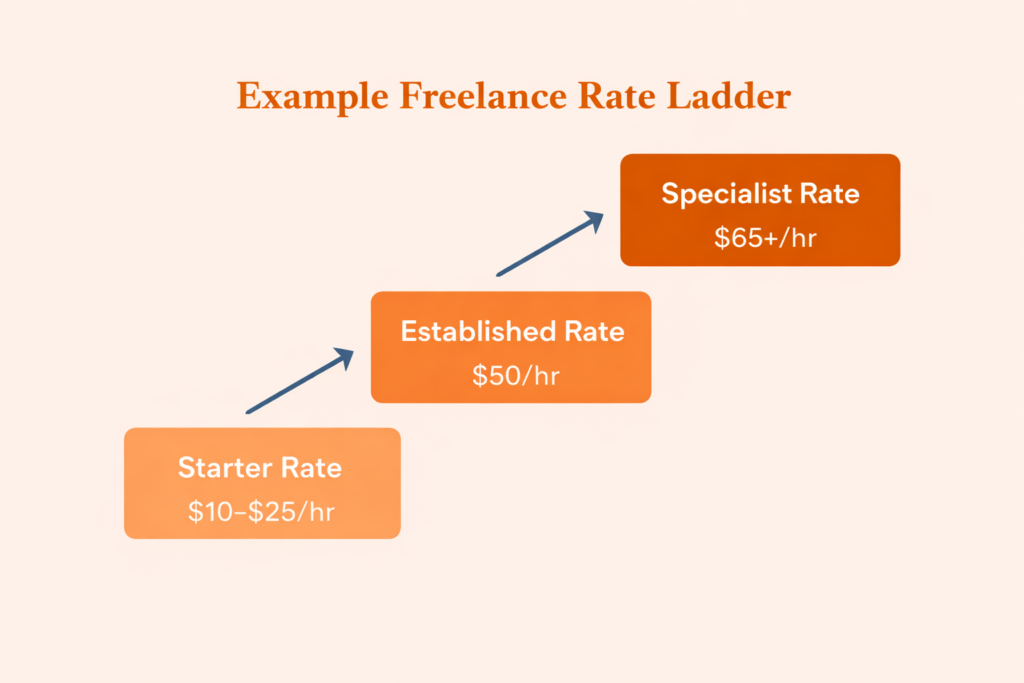
Rate increases follow a natural ladder: entry rate (what you charge to land your first clients), established rate (what you charge once you have completed projects and testimonials), and specialist rate (what you charge as a recognized expert in a narrow niche).
For new clients, the transition between tiers is simple: just quote the new rate. For existing clients, an annual rate review is appropriate and expected in professional services. A short email noting that your rates are increasing as of a specific date, with reasonable notice (typically 60 to 90 days), is professional and rarely results in losing a good client.
The negotiation skills that apply to salary discussions at your day job apply here too. For the mindset and specific language behind rate conversations, the same principles covered in How to Negotiate a Raise or Promotion translate directly to freelance rate-setting.
Managing Freelancing Alongside Your Primary Job
The most common freelancing mistake is taking on more than you can absorb without burning out your energy for the job that still pays your salary and benefits.
The solution is to define your freelance time budget before you take on your first client. Not after, when you are already committed and behind. A clear answer to “how many hours per week can I give to this without it affecting my primary job or my life” is the constraint everything else gets scoped inside.
Five to ten hours per week is a sustainable starting range for most people. That is one to two hours on weekday evenings, or a focused block on one weekend day. At a professional rate of $75 to $100 per hour, five hours per week produces $1,500 to $2,000 per month before tax. That is a material change to a FIRE timeline, from a commitment that does not consume your existence.
Communication hygiene matters. Set response windows with clients (for example: replies within 24 hours on business days). Do not create the expectation that you are available at all times: that expectation is hard to walk back later. Scope management is the other half of this: projects that creep beyond the original agreement creep into your protected time. Address scope expansion early, in writing, before you have already done the extra work for free.
Freelancing should serve your FIRE timeline, not become a second full-time job. The moment it starts to feel like the latter, the answer is not to push harder. It is to raise rates, narrow the scope, or let a client go. For more on protecting your time and avoiding burnout in side income work, see Best Side Hustles for FIRE.
Taxes and Invoicing Basics for Freelancers
In the US, freelance income is subject to self-employment tax (15.3% on net earnings) in addition to regular income tax. Unlike employment income, no employer is withholding this on your behalf: you are responsible for setting it aside and paying it quarterly as estimated taxes.
The standard guidance is to set aside 25 to 30% of every freelance payment for taxes. Putting this money directly into a separate savings account when each payment arrives, before you spend or invest it, removes the temptation to treat it as available income.
Quarterly estimated taxes (Form 1040-ES) are due in April, June, September, and January. Missing these payments results in penalties even if you pay in full at year end. Mark the dates in your calendar from the start.
The upside of self-employment is a meaningful set of deductions. Expenses that are ordinary and necessary for your freelance work are generally deductible: home office, equipment, software and subscriptions used for client work, professional development, and a portion of your phone or internet bill if used for freelance purposes.
Keep records. A simple spreadsheet logging income and expenses by category, updated monthly, is sufficient for most solo freelancers in the early stages. This content is informational only. It is not tax advice. Consult a qualified tax professional for your specific situation, especially as income grows.
What This Looks Like in Practice: Alex’s Story
Alex is 31, a UX designer at a tech company earning $72,000 a year ($4,800/month take-home after tax). His monthly expenses are $3,600, and he invests $1,200/month: a savings rate of 25%. At a 7% real return and starting from his current portfolio balance, his FIRE timeline is approximately 30 years.
Alex’s freelanceable skill is UX and UI design. He narrows it to a specific service: UI audits and wireframe packages for early-stage SaaS startups preparing for their first design hire. His rate is $85/hour. He reaches out to three former colleagues and one LinkedIn connection in his network.
In Month 1, one connection refers him to a startup founder who needs a UI audit. Alex completes the project in 8 hours, charges $680, delivers on time, and collects a testimonial.
By Month 3, he has two clients. He is working roughly 10 hours per week on evenings and one weekend morning. After setting aside 28% for taxes, his net freelance income is approximately $850 per month. He routes all of it into his investment account.
By Month 6, one of his clients proposes a retainer: ongoing UI support for new product features, budgeted at 10 to 12 hours per month, at $1,200/month. Alex accepts.
| Before Freelancing | Month 6 (Retainer Active) | |
|---|---|---|
| Monthly invested | $1,200 | $2,050 (approx.) |
| Annual expenses | $43,200 | $43,200 (unchanged) |
| FIRE number | $1,080,000 | $1,080,000 (unchanged) |
| Savings rate | 25% | ~43% |
| Est. years to FIRE | ~30 years | ~20 years |
Alex did not leave his company. He did not build a startup. He did not work every night. He landed one retainer client at modest hours, and cut a decade off his FIRE timeline in six months of focused setup work.
Run your own version of this scenario in the FIRE Calculator to see what different income and savings rate combinations mean for your specific timeline.
Recommended Reading
These three books cover the skills and mindset that matter most once you start freelancing: negotiation, clarity about what you’re building toward, and making the income work once it arrives.
- Never Split the Difference (Chris Voss): Freelancing is full of negotiations: rate conversations, scope discussions, client pushback, retainer proposals. Voss built this framework from real-world high-stakes negotiation, and the tactical language is directly usable in client conversations. One of the most practical books in the FIRE and personal finance library for anyone who earns by selling their expertise.
- Work Optional (Tanja Hester): Freelancing, for many people, is not just a FIRE accelerator. It is a transition toward a life where work is chosen rather than required. Hester’s book is one of the clearest frameworks for designing that transition: what “work optional” actually looks like in practice, how to build toward it intentionally, and how to make the shift without financial risk. Particularly relevant for anyone considering Barista FIRE or a gradual exit from full-time employment.
- I Will Teach You to Be Rich (Ramit Sethi): Once the freelance income starts flowing, the question becomes what to do with it. Sethi’s system for automating savings, investing, and spending allocation is the clearest available guide to making sure extra income actually reaches your investment account rather than disappearing into lifestyle drift.
As an Amazon Associate, I earn from qualifying purchases, at no additional cost to you.
FAQ
How much can I realistically earn from freelancing in the first 6 months?
It depends on your skill, your hourly rate, and how many hours per week you commit. A realistic range for someone with a professional skill, working 5 to 8 hours per week, is $500 to $1,500/month net of taxes by Month 3 to 4, once the initial setup and first client acquisition work is done. Month 1 is typically slower: expect to spend some of that time on outreach and first-project delivery rather than billable hours. The curve steepens once you have a testimonial and a completed project to reference.
Do I need a portfolio to get started?
Not necessarily. A portfolio of past professional work (anonymized where needed) is the fastest substitute for a client portfolio. Alternatively, one or two spec pieces (a sample email sequence, a fictional brief, a sample data analysis) created to demonstrate your capability, can serve the same function. What you need is evidence of quality, not a formal portfolio page. A Google Drive folder with two strong samples is a portfolio.
Can I freelance in the same field as my day job without conflict?
Possibly, but check your employment contract before you start. Many contracts include a non-compete or moonlighting clause that restricts paid work in the same field during employment. Some restrict only direct competitors; others are broader. Read the relevant sections carefully. If anything is ambiguous, a brief conversation with an employment lawyer costs far less than the risk of ignoring it. This is not legal advice. Do your own research and consult a qualified professional.
How do I handle clients who don’t pay on time?
Prevention is easier than cure: set clear payment terms in writing before the project starts, and do not begin work on subsequent phases until the prior invoice is paid. When a payment is late, a straightforward follow-up email referencing the original terms and due date is usually enough. For persistent non-payment, a polite but firm notice that work will pause until the account is current resolves most situations. For new clients, a 50% deposit upfront is standard practice in many freelance fields and eliminates the non-payment risk entirely for the first project.
What is the difference between freelancing and consulting?
In practice, the distinction is mostly a matter of positioning and scope. Freelancers typically deliver execution: they write the copy, design the interface, build the model. Consultants typically deliver advice and strategy: they diagnose the problem, recommend the solution, and leave implementation to the client or others. The same person can do both. At higher rates and with more experience, the word “consultant” tends to signal senior, strategic involvement. As a starting point, the distinction matters less than clarity about what you actually deliver and to whom.
Key Takeaways
- Freelancing has no income ceiling tied to hours, compounds the FIRE case directly, and offers location and schedule flexibility that conventional employment does not. It is one of the clearest paths to Barista FIRE for people who want to replace part-time income without the 9-to-5 structure.
- The skill audit is the starting point: what do colleagues ask you for? What feels routine to you but complicated to others? The answer is usually your service offer.
- Narrow beats broad. A specific service with a defined deliverable finds clients faster than a vague offer of general help.
- Set your rate backward from an income target, test it against market data, and start at a rate you can defend: not the lowest one that feels safe.
- Your existing network is the fastest path to a first client. Platforms work better once you have a completed project and a testimonial.
- Deliver, invoice, and ask for a testimonial while the project is fresh. That testimonial is your most valuable early asset.
- The goal is a retainer, not a series of one-off projects. One retainer client at modest hours changes the math significantly.
- Set aside 25 to 30% of every freelance payment for taxes from the start. Pay quarterly estimated taxes. Track deductions from day one.
Your Next Step
The single most useful thing you can do today is run the skill audit from Step 1. Write down your answers to the three questions. You are not committing to anything. You are building a picture of what you have to offer before deciding whether and how to offer it.
Once you have that picture, run your freelance income scenario in the calculator to see what even a modest retainer does to your timeline:
FIRE Calculator: Estimate Your FIRE Number & Years Until Financial Independence
And for the full framework on growing income beyond freelancing, including salary negotiation, side hustles, and the sequencing that tends to work best:
How to Increase Your Income: Proven Strategies to Reach FIRE Faster
This content is for informational purposes only and does not constitute financial advice. Do your own research (DYOR) and consider speaking with a qualified professional before making any financial decisions.