
You’ve been doing everything right. Tracking your spending, automating a savings transfer, maybe even starting to research index funds. The plan is finally taking shape, and for the first time in a while, financial independence feels less like a distant concept and more like an actual destination.
Then the car breaks down.
Or a dental bill lands. Or the washing machine dies. And just like that, the money you spent three months carefully accumulating goes straight onto a credit card. The balance goes up, the motivation takes a hit, and the plan that was working suddenly feels a lot more fragile than it did.
That cycle has a name: financial whiplash. And the fix isn’t more discipline or a tighter budget. It’s the one piece most people skip in their rush to start investing: an emergency fund. Not a “nice to have” buffer. A dedicated, intentionally sized, properly placed reserve that exists for one purpose only. This guide covers exactly how to build it: how much you need, where to keep it, and how to do it without stalling everything else.
What you’ll learn in this guide:
- What an emergency fund actually is (and what it isn’t)
- How much you need, including the FIRE-specific case for more
- Where to keep it so it earns something without being at risk
- How to build it in parallel with your other financial goals, not instead of them
- A worked example showing the full build from zero to fully funded
What Is an Emergency Fund (and What It Isn’t)
An emergency fund is liquid cash held in reserve for genuine, unexpected, necessary expenses. The three words matter equally. Genuine means something actually went wrong, not something you simply want. Unexpected means you couldn’t have planned for it. Necessary means it can’t wait.
A car breaking down qualifies. So does a sudden medical bill, a job loss, an urgent home repair, or an emergency flight home. These are real emergencies: situations where the alternative to having cash available is going into debt.
What doesn’t qualify: a sale you don’t want to miss, a forgotten annual bill (that’s a sinking fund problem, not an emergency), a vacation you’ve been meaning to take, or a planned expense that simply arrived sooner than expected.
This distinction matters because mixing these two categories is one of the main reasons emergency funds don’t stay funded. Once you blur the definition, the account becomes a slow-drain slush fund rather than a genuine safety net.
The emergency fund is also not an investment. Its job is not to grow. Its job is to be there, in full, the moment you need it. That shapes every decision about where to keep it and how much you actually need.
One more thing worth clarifying: the emergency fund comes before investing for most people. Not because investing isn’t important (it’s critical), but because without a funded emergency reserve, the first unexpected expense will likely either create new debt or force you to liquidate investments at the worst possible time. Starting to invest on a solid foundation is more valuable than starting faster on a fragile one.
How Much Do You Actually Need?
The Standard Advice (and Why It’s Not Always Right)
The conventional benchmark is 3 to 6 months of essential expenses. This is a reasonable starting point, but understanding what it actually means makes it considerably more useful.
Essential expenses are not your total spending. They’re the costs that have to be paid regardless of what else is happening in your life: rent or mortgage, utilities, groceries, basic transportation, insurance, and minimum debt payments. Not subscriptions. Not dining out. Not discretionary shopping. Just the irreducible floor of what your life costs per month when you strip everything non-essential away.
If you’ve already been tracking your spending, you can calculate this number in ten minutes by pulling your fixed costs and basic variable costs from the last month or two. If you haven’t started tracking yet, do that first: it’s the foundation everything else here is built on.
Once you have your monthly essential expenses figure, the formula is simple: multiply by your target months. Three months minimum. Six months if your situation calls for it (more on that below).
The FIRE-Specific Case for More
Standard 3-to-6 month advice was designed for people in stable salaried employment with employer-provided benefits. The FIRE context often looks different, and the right fund size reflects that.
If you’re self-employed or have variable income, 6 to 12 months is more appropriate. Your income can drop without warning, and the recovery time is less predictable than it would be for someone back in employment within a few weeks.
If you’re planning to leave a job in the next 12 to 24 months, whether to pursue FIRE, start a business, or take a career break, a larger fund makes the transition far less stressful. The gap between leaving a salary and your next income source, whether that’s portfolio withdrawals, freelance income, or something else, is exactly the kind of situation an emergency fund is designed to bridge.
Healthcare is a specific factor worth calling out. If you’re currently on employer-sponsored health insurance and planning to leave that coverage, your out-of-pocket risk increases significantly. A gap in coverage, or a period on a marketplace plan with a high deductible, changes the calculus for how much liquid reserve makes sense.
In early retirement, the standard recommendation extends further. The sequence-of-returns risk that makes the first few years of retirement so critical (covered in depth in the 4% rule article and the early retirement guide) is specifically why many FIRE practitioners keep 1 to 2 years of expenses in cash or near-cash outside their investment portfolio. The goal is to avoid selling equities during a downturn while you’re already withdrawing.
A Practical Starting Target
If the full calculation feels overwhelming, start with a stepped approach that gets you protected fast without requiring perfection upfront.
Step one: get to $1,000. This immediate buffer absorbs the small shocks (a car repair, a doctor visit, an unexpected bill) that derail most early-stage financial plans before they gain momentum. It’s not a full emergency fund, but it’s vastly better than zero.
Step two: build to 3 months of essential expenses. This is the real target for most people in stable employment. Once you’re here, the most common emergencies are covered, and you can start investing in parallel with confidence.
Step three: reassess based on your situation. Variable income, a planned career transition, or proximity to FIRE may push your target higher. The table below gives a quick guide.
| Your situation | Recommended range |
|---|---|
| Stable employment, no major transitions planned | 3 to 6 months |
| Variable income or self-employed | 6 to 12 months |
| Planning to leave a job within 12 to 24 months | 6 to 12 months |
| In early retirement or transitioning to FIRE | 12 to 24 months |
Where to Keep Your Emergency Fund
Why It Doesn’t Belong in a Checking Account
A checking account earns essentially nothing. More importantly, it offers no behavioral separation from everyday spending. When the line between “money for bills” and “emergency reserve” lives in the same account, the reserve tends to quietly erode over time. It gets used for things that aren’t true emergencies, partly because there’s no friction stopping it, and partly because it doesn’t feel like a separate resource. It just feels like money.
Keeping your emergency fund in a distinct account at a separate institution solves both problems. The yield improves, and the psychological distance makes you think twice before dipping in.
High-Yield Savings Accounts: The Default Choice
A high-yield savings account (HYSA) is the standard recommendation for emergency funds, and for good reason. It’s FDIC-insured (meaning your money is protected up to $250,000 per depositor), it earns meaningfully more than a standard savings account, and it stays liquid: you can transfer to checking within one to three business days when you actually need it.
The yield matters more than people think. At a 4% APY, a $12,000 emergency fund earns roughly $480 per year. At a 5% APY, a $20,000 fund earns $1,000. That’s not an investment return, but it’s also not dead money. The fund is doing a job (protecting you from debt) and earning something while it does it.
When choosing a HYSA, the key features to compare are the annual percentage yield (APY), whether there’s a minimum balance requirement, FDIC insurance, and how quickly transfers to your main checking account clear. Most reputable online banks offer competitive rates with no minimum balance and same-day or next-day transfers.
A note on where to open it: a different institution from your primary checking account is worth the small setup friction. The transfer delay (usually one to two business days) is long enough to give you pause before withdrawing for a non-emergency, but short enough to be genuinely useful when something real happens.
What About Money Market Accounts and Short-Term Bonds?
Money market accounts offer similar yields to HYSAs with some additional flexibility (some offer check-writing features). They’re a reasonable alternative, particularly if you already have an account at a brokerage that offers one.
Short-term bond funds and Treasury bills can offer marginally higher yields, but they carry a small amount of price risk: the value can fluctuate slightly before maturity, which means you might sell at a minor loss if you need the money at an inopportune moment. For most people building an emergency fund, that tradeoff isn’t worth the extra yield. The point of this money is reliability, not optimization.
For readers approaching early retirement with a larger cash buffer in mind, the 4% rule article covers how cash reserves and bond allocations interact in the distribution phase in more detail.
For most beginners: a HYSA is the right answer. Keep it simple.
How to Build It Without Pausing Your FIRE Progress
The Parallel Approach
The most common mistake people make when building an emergency fund is treating it as something that has to be completed before anything else can begin. “I’ll build the full fund, then I’ll start investing.” The problem is that this approach can mean 12 to 18 months of zero investing during what might be some of your highest-earning years. That’s a real cost.
A better approach runs both goals in parallel. Not equally: your allocation will shift as you build toward fully funded. But you don’t have to stop entirely.
The one non-negotiable exception: if your employer offers a 401(k) match, contribute enough to capture it before directing any extra money anywhere, including the emergency fund. An employer match is an immediate 50 to 100% return on your contribution. No emergency fund yield, no debt payoff rate, and no investment return comes close to that. Skipping free money to build a savings account faster is almost never the right trade.
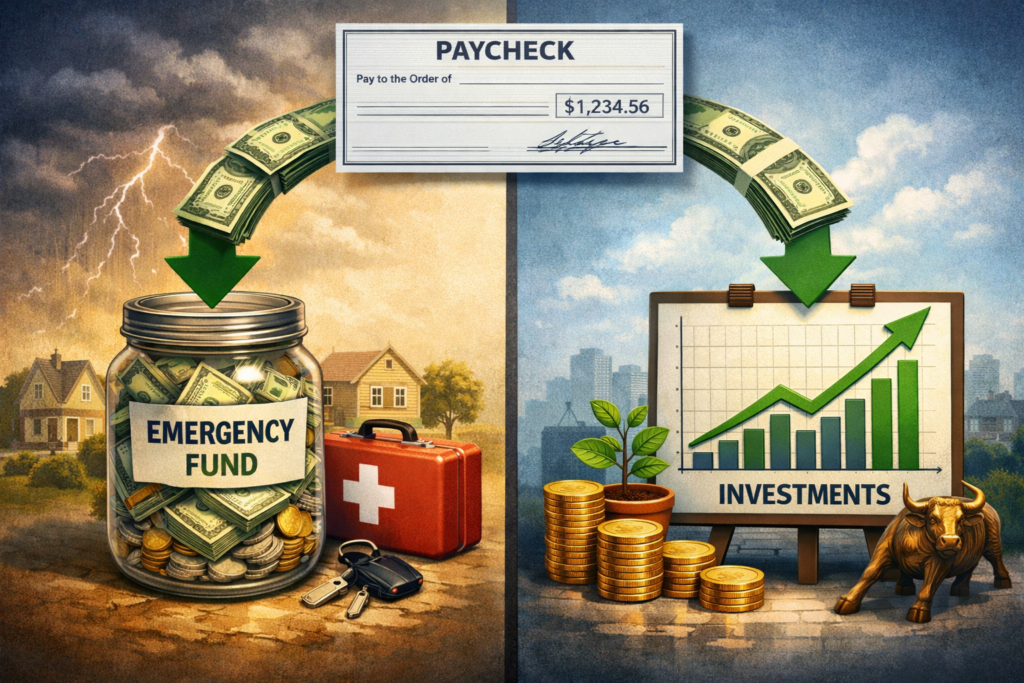
Beyond the match, a reasonable split while building the fund: direct the majority of your surplus toward the emergency fund, and a smaller amount toward investing. Once the fund is fully built, redirect the entire emergency fund contribution into investments.
Pay Yourself First, Applied Here
The same principle that makes saving and investing work also applies to building an emergency fund: automate it on payday, before you have a chance to spend the money.
Set up a separate automatic transfer to your HYSA the day your income arrives. Even $100 to $200 a month gets you to a $1,000 buffer in five to ten months, and to a three-month fund in a reasonable timeframe depending on your essential expenses. The amount matters less than the automation. When the transfer happens automatically, it removes the monthly decision-fatigue of “should I save this or does it go toward something else?”
Treat it like a fixed bill that happens to be paid to your future self.
Where to Find the Money
If your budget is already tight, the emergency fund contribution has to come from somewhere. Two places to look first.
The Keep, Cut, Replace framework in the savings guide is the fastest way to find real room in your current spending: protect what you value, cut what you don’t notice, and swap expensive habits for cheaper alternatives. Even $150 to $200 per month freed up here, directed at the emergency fund, gets you to $1,000 in a matter of months and to a three-month fund within a year or two.
Windfalls are the other lever. Tax refunds, bonuses, overtime pay, gift money: these are irregular but often predictable, and they can dramatically compress the timeline. Before a windfall gets absorbed into lifestyle spending, direct it at the fund first. You were already living without it.
If you want a structured way to track both your spending and your emergency fund progress, the free budget tracker below works well for this:
Download the free Budget Tracker
Worked Example: Building the Fund Without Stalling FIRE
To make this concrete, here’s what the full build looks like for someone starting from zero.
The situation: Camille is 31 and earns $4,200 per month after tax. She has no emergency fund, a small amount in a checking account that regularly gets spent down, and a savings rate of roughly 14% (about $600 per month). She wants to start investing properly but knows she needs the emergency fund in place first. Her essential monthly expenses are $2,100 (rent, utilities, groceries, transportation, insurance, minimum debt payment).
Her target: 3 months of essential expenses = $6,300.
Her approach:
- Increase her 401(k) contribution to 4% to capture her employer’s full match (she was leaving free money on the table at 2%)
- Direct $400 per month to the HYSA (emergency fund)
- Direct $200 per month to a brokerage account (investing doesn’t stop entirely)
The build timeline:
| Milestone | Timeline | Emergency fund balance | Monthly investing |
|---|---|---|---|
| $1,000 immediate buffer | Month 2.5 | $1,000 | $200 (brokerage) + employer match |
| 1 month of essentials ($2,100) | Month 5 | $2,100 | $200 (brokerage) + employer match |
| 3 months of essentials ($6,300) — FULLY FUNDED | Month 16 | $6,300 | $200 (brokerage) + employer match |
| After fully funded — full redirect | Month 17 onward | Maintained at $6,300 | $600 per month (brokerage) + employer match |
What changes at month 17: the $400 that was going to the emergency fund is now fully redirected to her brokerage account. Her total monthly investing triples overnight, from $200 to $600, plus the 401(k) match that’s been running throughout. She didn’t earn more money. She just unlocked the full investing contribution that was temporarily allocated to building the safety net.
The FIRE connection: Camille’s essential expenses of $2,100 per month equal $25,200 per year. Using the FIRE calculator with the 25x rule, her current FIRE number is $630,000. With $600 per month going into a diversified index fund portfolio from month 17, and a 7% real annual return, she reaches approximately $190,000 in 15 years, with compounding accelerating the final stretch significantly.
The 16 months it took to build the emergency fund didn’t derail the plan. They set it up properly.
What Counts as an Emergency (and What Doesn’t)
Once the fund is built, the question becomes how to use it without eroding it for the wrong reasons. A simple test works better than a long list of rules: is this expense unexpected, necessary, and time-sensitive? If all three apply, it’s a real emergency. If any one of them doesn’t, it probably isn’t.
Clear emergencies: job loss that cuts off income, a medical or dental bill not covered by insurance, a car breakdown that prevents you from getting to work, an urgent structural repair at home (roof leak, heating failure), emergency travel for a family situation.
Not emergencies: a sale you don’t want to miss (it was never in the plan), a forgotten annual subscription renewal (that’s a sinking fund gap), a planned car service that you knew was coming, a vacation you’ve decided you want to take. These are real costs, but they’re plannable costs. Building sinking funds for regular irregular expenses is the right tool here, not the emergency fund.
One practical habit that helps: when you’re tempted to dip in, write down what the expense is and apply the three-question test before transferring the money. The small delay frequently reveals that the situation is inconvenient but not genuinely urgent.
Common Mistakes
Using it for non-emergencies and not replenishing it. The fund only works if it’s available in full when you need it. If it’s been partially spent on non-emergencies, the next real emergency still creates debt. When you use the fund legitimately, replenishing it becomes the immediate next financial priority, ahead of discretionary goals.
Keeping it in a regular checking account. Zero yield and zero psychological separation. Both are solved by a HYSA at a separate institution. This is one of the easiest changes to make and one of the most impactful.
Waiting until the fund is complete before investing at all. As covered in the worked example, a parallel approach captures the employer match and keeps compounding running throughout the build. The cost of pausing completely is real over a 12 to 18 month period.
Setting an amount and never revisiting it. Your essential expenses change as your life changes. A fund calibrated to your $2,000-per-month lifestyle from three years ago may not be sufficient for a $3,200-per-month lifestyle today. Review the target once per year alongside your broader financial review.
Over-optimizing: investing the emergency fund for higher returns. T-bills, bond ETFs, dividend stocks: these feel more productive than a HYSA, but they all carry some combination of price risk, liquidity lag, or capital gains complexity. The emergency fund’s value is its reliability. Chasing an extra 1% on this specific money is a bad tradeoff.
Recommended Reading
If you want to go deeper on the principles behind building financial stability and resilience, these three books sit at the intersection of practical personal finance and the FIRE framework:
- The Index Card (Helaine Olen & Harold Pollack): ten simple rules for personal finance that fit on a notecard, and building an emergency fund is among them. For the reader who wants clarity before complexity, this is the cleanest starting point.
- You Need a Budget (Jesse Mecham): YNAB’s four-rule method includes the concept of “rolling with the punches” (absorbing unexpected expenses without derailing the plan) and “true expenses” (anticipating irregular costs). Both connect directly to what the emergency fund is for and how it interacts with the rest of your financial system.
- Get Good with Money (Tiffany Aliche): Aliche’s ten-step plan places the emergency fund explicitly early in the sequence, framed as “the thing that protects everything else you build.” Particularly valuable for readers who feel behind or are rebuilding after a financial setback.
As an Amazon Associate, I earn from qualifying purchases, at no additional cost to you.
FAQ
How much should I have in my emergency fund?
For most people in stable employment, 3 to 6 months of essential expenses is the right target. Essential expenses are the non-negotiable monthly costs: rent or mortgage, utilities, groceries, basic transport, insurance, and minimum debt payments. If your income is variable, you’re self-employed, or you’re planning a major career transition in the next year or two, lean toward 6 to 12 months. In early retirement, 12 to 24 months in liquid form is standard practice in the FIRE community.
Should I build my emergency fund before investing?
Mostly, yes, but with one important exception. If your employer offers a retirement account match (like a 401(k) match), contribute enough to capture the full match before directing extra money anywhere, including the emergency fund. That match is free money you can’t recover later. Beyond the match, a parallel approach works well: direct the majority of your monthly surplus toward the emergency fund while keeping a smaller amount going into investments. Once the fund is fully built, redirect everything to investing.
Where is the best place to keep an emergency fund?
A high-yield savings account (HYSA) at a separate institution from your primary checking account is the standard recommendation. It earns a meaningful APY (currently in the 4 to 5% range at many online banks), is FDIC-insured, and keeps the money liquid with a 1 to 3 business day transfer window. The psychological separation from your checking account also helps prevent the fund from being used for non-emergencies.
What if I already have debt? Do I still need an emergency fund?
Yes, but you don’t need the full fund before starting debt payoff. The debt payoff guide covers this in detail, but the short version is: build a minimal $500 to $1,000 buffer first. This small reserve exists to break the debt-emergency-debt cycle: without it, the next unexpected expense goes straight back onto the credit card, undoing your payoff progress. Once you have the buffer, attack debt aggressively. Build the full emergency fund after the high-interest debt is cleared.
How do I replenish the fund after using it?
Replenishment becomes the immediate next financial priority after a legitimate withdrawal: ahead of extra investing, ahead of discretionary goals, ahead of anything non-essential. Restart your automatic HYSA transfer and treat it the same way you did during the original build. If the withdrawal was large, consider temporarily redirecting more surplus toward replenishment until the fund is fully restored.
Does my emergency fund count toward my savings rate?
While you’re building it, yes: contributions to your emergency fund count as saving and can be included in your savings rate calculation. Once it’s fully funded, those contributions redirect to investing and continue to count. The fund itself, once built, is not an investment: it doesn’t factor into your portfolio value or FIRE number. It’s a separate reserve that protects your ability to stay the course with everything else.
Key Takeaways
- An emergency fund is liquid cash held exclusively for genuine, unexpected, necessary expenses. Its job is reliability, not growth.
- Target 3 to 6 months of essential expenses for stable employment. Extend to 6 to 12 months for variable income or planned transitions, and 12 to 24 months in early retirement.
- A stepped approach reduces overwhelm: get to $1,000 first, then build to 3 months, then reassess.
- A high-yield savings account at a separate institution is the right place for this money. It earns something, stays liquid, and creates behavioral separation from everyday spending.
- Build it in parallel with investing, not instead. Always capture your employer’s 401(k) match. Then split surplus between the emergency fund and investing until fully funded.
- Automate the transfer on payday. Treat it like a fixed bill paid to your future self.
- Once funded, maintain it. Replenish after any legitimate withdrawal before resuming other financial goals.
Your Next Step
Calculate your essential monthly expenses: rent or mortgage, utilities, groceries, basic transport, insurance, minimum debt payments. Multiply by 3. That’s your initial target. If you don’t have a HYSA yet, open one this week at a separate bank from your checking account. Set up an automatic transfer for payday, even if it starts small. The emergency fund doesn’t need to be built in a month. It needs to be started.
Once the fund is in place, you can run your full numbers here:
FIRE Calculator: Estimate Your FIRE Number & Years Until Financial Independence
If you want to find room in your current spending to fund the emergency fund faster:
How to Save More Money: 3 Simple Tips to Improve Your Spending Habits
If you’re carrying debt and want to know how an emergency fund fits into the payoff strategy:
How to Pay Off Debt: A Simple Strategy That Still Builds Toward FIRE
And if you’re ready to understand the full investing picture once the fund is built:
How to Start Investing for Beginners: A Simple Guide to Your First Investment
As an Amazon Associate, I earn from qualifying purchases, at no additional cost to you.
This content is for informational purposes only and does not constitute financial advice. Do your own research (DYOR) and consider speaking with a qualified professional before making any financial decisions.